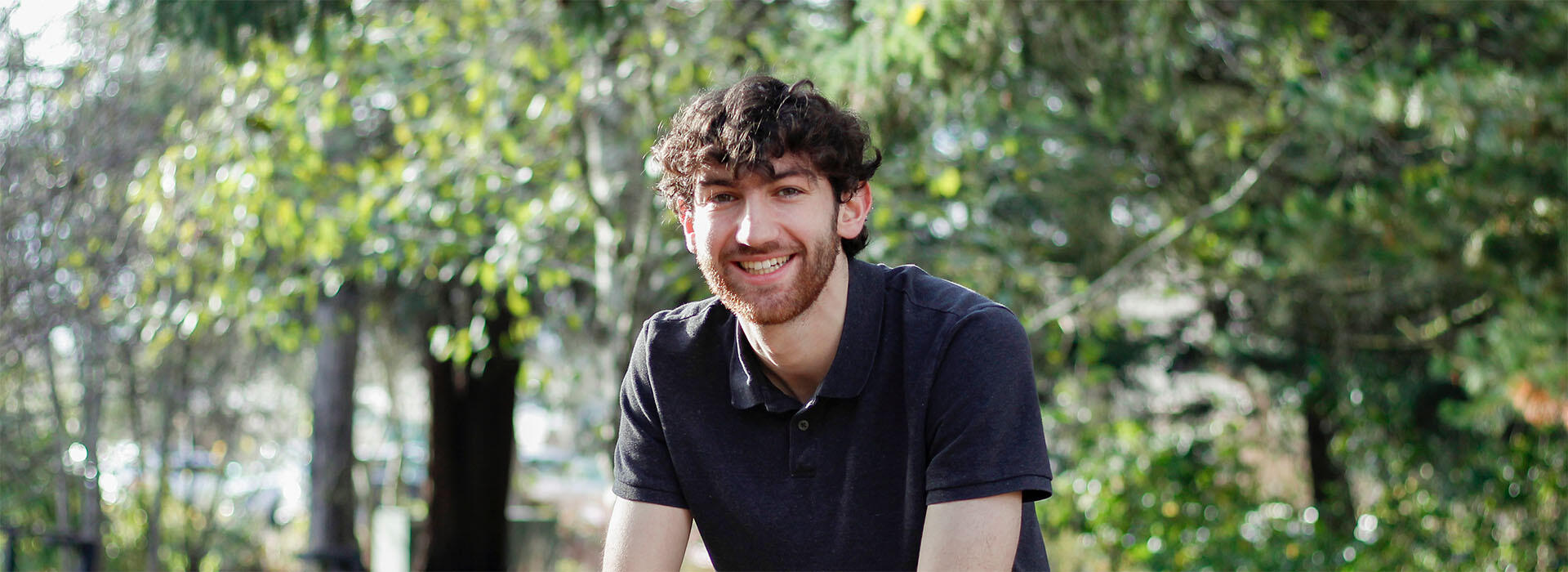
Story by Jennifer Rouse | Photo by Jubair Islam
An international climate research experience helped one OSU student discover that impact isn't just what you choose to study. It's how you choose to take action.
When Tias Carney showed up in Corvallis from Juneau, Alaska, as a freshman in OSU's Honors College, there were a lot of things he knew he liked about Oregon State: the outdoorsy environment. The D1 sports. The variety of academic programs offered. What he didn’t know?
Which of those programs he wanted to pursue.
“I really like numbers, and so I thought about being like a math major. I thought about engineering as well, so I took the intro classes, and I just knew it was not for me. Most of my friends went into computer science, but I didn’t want to do that,” he said. “I was like, ‘What DO I want to do?”
Following curiosity to a meaningful degree
By May of his freshman year, he was still undecided. Then he saw an advertisement for an OSU alumni panel featuring a graduate who had studied climate science.
“I was like ‘Climate Science, what is that? I don’t know why I’ve never heard about that.’”
Carney had always had an interest in nature, from a childhood spent in outdoor recreation with his family to high school experiences studying oceanography – but he’d never seriously considered building a career around it.
Photo courtesy of Tias Carney
"With Climate Science, there was an aspect of doing what I really cared about, which was climate change. "
- Tias Carney
Carney attended the alumni panel, only to discover that the alum, Alan Huston, ’20, had to miss the event due to a last-minute conflict. By then, Carney was so curious about Climate Science that he asked the organizer of the panel for Huston’s email and followed up with questions, to which Huston quickly responded with answers and encouragement.
Carney continued his deep-dive, researching potential climate science courses in MyDegrees ("all the descriptions and titles sounded fascinating to me" he recalls) and talking to people in the program. Things were beginning to click.
“There was this aspect of doing what I really cared about, which was climate change,” he said. “It was something that I had a background in, something I cared about. It was something that I could be really motivated for.”
Within days of emailing Huston, he had officially changed his major.
Finding success when the obvious paths didn’t work
Over the next two years at OSU, Tias deepened his involvement, volunteering with the National Weather Service in his hometown of Juneau during winter and summer breaks, staying involved with the Honors College, and becoming president of OSU’s chapter of the American Meteorological Society. One thing was missing: hands-on internship or research experience.
Tias applied to a number of different competitive programs with NOAA and other climate science groups, but ultimately didn’t land any of the roles.
So he pivoted. Taking to heart advice he had heard over and over again from his OSU career advisor about the importance of networking, Carney reached out to a family friend who had a connection at the Danish Meteorological Institute, Ruth Mottram. He looked up Mottram's research, her background, and spent time carefully crafting a cold email asking about student research opportunities on her team.
“Honestly, I almost didn’t send the email,” he said. “I was so uncertain.”
But he took a shot, hit send – and for over a month, heard nothing. He chalked it up to one more thing that probably wasn’t happening. But after he heard back from the very last NOAA internship that he hadn't been selected, he decided to try reaching out to Mottram one more time.
This time, his persistence paid off: Mottram responded to Carney's follow-up, invited him to a Zoom interview, and by the end of June, Carney was on his way to Denmark.
Copenhagen photo by Tias Carney
Inside the science (and the community behind it)
In Denmark, Carney found himself immersed in an entirely different work and life culture, where he biked the streets of Copenhagen daily and worked side by side with scientists from Mexico, Poland, Canada, India, Denmark, France and Estonia. Carney’s project at the Danish Meteorological Institute involved analyzing data from melting ice sheets in Greenland and Antarctica and comparing them with established climate models, with the ultimate goal of developing a better understanding of which climate models best predict future melt.
For Carney, it was a summer of discovering what life in another country could be like, and what life doing hands-on climate research and data coding could be like.
“The work environment was just fantastic,” Carney said. “The collaboration – people were all working on different projects at the same time, and how they put those together was really fascinating. You had different entities, different universities. People around me were from all different places, which was so cool.”
By the end of the summer, Carney had not only built the beginnings of a career – he’d built community. He played basketball in the park, went to FC Copenhagen games, and stayed after hours for rounds of MarioKart on the big screen in the presentation room with his co-workers.
He also returned still reflecting on a familiar question: how can my career make an impact on climate change?
Photo courtesy of Tias Carney
From studying the problem to changing the system
Back in the U.S., Carney was wrapping up his Honors B.S. in Climate Science, finishing his honors thesis, and thinking about next steps: grad school? Applying for a Fulbright or NWS Pathways program? Whenever he tried to write a statement of purpose for his applications, he got stuck, unsure what research topic he wanted to devote himself to for months or years.
As he reflected on his summer spent coding, he realized that although he’d always pictured himself pursuing a math- or science-related career, his options for making an impact were actually much broader.
“A lot of the work I did, even on melting sea ice, was great research. And that’s really important,” he said. “But the research that comes out – It's also important that it gets understood. That it gets used, from a policy perspective. That’s where I really feel we can make change.”
Once more, Carney turned to his network, seeking out family friends and advisors with expertise in law and policy. And he’s once more following his curiosity to chase an impactful career. He’s applying to law school.
“I had kind of written off law and policy type things because I haven’t always been the strongest writer, but my writing has really grown through being a student here,” Carney said.
“I feel like I can really make a big difference in that field. I’m really interested in environmental law. I’m not going to abandon the climate – that’s what I really care about.”
It's important that research gets understood. That it gets used, from a policy perspective. That's where I really feel we can make change.
- Tias Carney
Want to pursue an international internship? Seeking a career that makes a meaningful impact?
Start here:
- Get inspired by talking to real alumni and real professionals working in careers you want to pursue. Find alumni panels and career events happening at OSU at the Career Development Center’s career events page or on Handshake.
- Oregon State offers international internship and research opportunities all over the globe. Visit OSU GO to learn more.
- Tias built his resume through volunteering and joining clubs and organizations related to his field. Find volunteer opportunities and OSU chapters of professional organizations (Filter student orgs by "Academic & Professional").
- Want to arrange your own research or internship experience, like Tias did? Get tips for networking with professionals and reaching out to researchers.
- Need financial support to make your international experience or research possible? The CEOAS Experiential Learning Fund supplemented costs for Tias on his trip; many other colleges, clubs and organizations offer funding you can apply for. Contact the career advisor for your college (find them via Beaver Hub) to discover what is possible for your area of study.
Related Stories