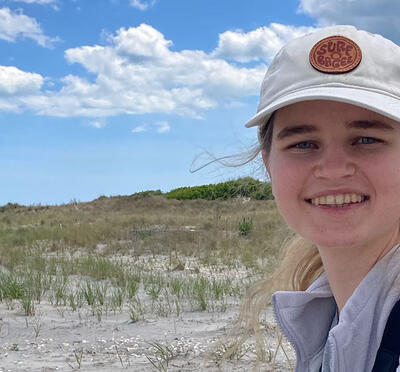
Photo credit: Jubair Islam | Story by: Jennifer Rouse
OSU’s blend of mentorship, hands-on learning, and early research opportunities helped Rebecca Knight pivot from undecided major to ocean scientist
When Rebecca Knight first started college, freediving off a research vessel and helping Oregon State researchers uncover how microscopic fishes move through coastal waters seemed out of reach – until encouragement from her advisor and the culture of research she discovered at OSU steered her towards a career in ocean science and an unforgettable summer research experience.
The advice that gave her permission to try
Knight grew up in Bend, Ore. and had a long-standing interest in marine life and oceans, but she entered OSU as a liberal arts major with an undecided focus.
“I did not think I was smart enough to do what I really wanted to do,” Knight said.
Still, she kept returning to the idea that she really wanted to study the world’s oceans. So she went to talk to her advisor, Casey Menn.
“He wasn’t corny about it,” Knight recalled. “He didn’t say ‘You can do anything you put your mind to.’ His idea was more like, ‘It’s irrelevant if you think you can do it or not. You haven’t even tried yet.’”
Knight took that to heart and switched from the College of Liberal Arts to the College of Earth, Ocean and Atmospheric Sciences. This is a common experience at OSU, where strong first-year support from both academic and career advisors helps the 30-40 percent of students who change colleges find the academic path that’s right for them.
From Knight’s first oceanography class – OC 201 with Dr. Miguel Goni – she knew she’d made the right choice.
“I was hooked,” she said. “And by the time I got to the things I really struggled with, I was so motivated by my love for oceanography as a discipline that I could get through integral calculus and physics.”
When 30 rejections led to one big yes
Fast forward to junior year: three years at OSU, one of the world’s top oceanography schools, had paid off for Knight. She had taken part in a field oceanography cruise on the research vessel Sally Ride, learning to use sophisticated shipboard equipment. She had participated in URSA Engage, Oregon State’s early-college research program. And she hoped to land a summer research position with the National Science Foundation.
“I applied for about 30 positions and did not get a single one,” she said. “The first rejection letter, you're like, ‘c’est la vie.’ But by the 30th, you're like, ‘I can't do this anymore.’”
Knight once again sought help from her adviser. Menn suggested the professional but proactive approach OSU recommends to aspiring researchers: rather than waiting for new positions to post, she should reach out personally to researchers.
“I was like, ‘I don't want to do that. Just…asking? I'm not very good at asking for things,’” Knight said. “He was like, ‘Well, do you want it or not?’”
Turns out Knight really did want it.
So she got to work, emailing many of the professors and researchers associated with Oregon State. She attached her CV, described her availability and her interests, and mentioned how she had learned about the researchers’ work. And when she emailed Su Sponaugle, a marine ecologist at OSU’s Hatfield Marine Science Center, her efforts paid off – Sponaugle offered her a summer position at the Plankton Ecology Lab.
A summer in the lab and on the water
Knight spent her summer on research that helps scientists understand more about the way tiny juvenile fishes move through Oregon’s nearshore ocean waters.
Because OSU operates campuses in both Corvallis and Newport, Knight was able to fit together classes at the Newport campus with her research schedule. Support from the College of Earth, Ocean and Atmospheric Sciences’ Experiential Learning Fund helped make that blend of coursework and hands-on science possible. For some of her research, she was in the lab, examining fish larvae and recording data; on field days she headed offshore on the Oregon Coast Aquarium’s research vessel Gracie Lynn, freediving to collect SMURF (Standardized Monitoring Units for the Recruitment of Fishes) traps from marine reserve areas.
The opportunity for hands-on experience working on a research vessel brought some unforgettable moments – such as the time when a researcher from the aquarium accompanied the team and brought on board a large red plastic trash can with a bungee cord securing the lid. After a while, the boat paused, and when Knight asked why they were stopping, she was told, “Oh, we have to release this octopus.”
“I was like, we have to release the what???” she recalled.
Sure enough, the researcher removed the lid and revealed a live octopus.
“There's this sling device she gets it into, and they dump it over the edge and it swims away. It was so cool,” Knight said. “It was just another day for them. But that was the coolest thing I've ever seen, you know?
Failing forward and finding her path
Now back at the Corvallis campus, Knight is finishing coursework and preparing for grad school – she’s even written a research proposal based on her summer work. If she were giving advice to students interested in the kinds of hands-on research she’s been a part of, it would be this: don’t be afraid to ask for help. And don’t be afraid to fail.
“I’ve benefited from all kinds of people at OSU who were kind to me in ways they didn’t have to be,” Knight said. “And I’ve also failed a lot. I failed trigonometry the first time I took it here. I failed PH211 the first time I took it here."
"I never thought to myself, ‘Oh, now I'm not going to get the oceanography degree. I always thought, ‘Now I'm going to take this class again and keep going.’”
Knight can see how all her experiences at OSU – even the failures – have given her both the experiences and the confidence for her next steps.
“I’ve done the field work. I know how to take the samples. I felt set up really well to write something and be actually knowledgeable about it,” she said. “I feel very lucky to have been a part of this.”
Photo credit: Rebecca Knight
How to land your own research experience: finding research & internship support at OSU
Know how to connect with an advisor
- OSU students have an academic advisor and a career advisor who are here to help you find the right pathway to what you want to do. You can connect with both through your Beaver Hub success team.
Know how to get involved in research as an undergrad
- OSU is an R1 research institution with multiple pathways for undergraduates to get involved in research. Knight credits the URSA Engage program as being helpful to her success.
Know how to reach out for professional connections.
- When applying for internships the traditional way didn’t work, Knight emailed researchers to find out about potential ways to get involved. Sometimes it’s tough to know what to say when you’re reaching out to a stranger! Use templates and guides from the Office of Undergraduate Research and Career Development Center to help.
Know how to seek out funding
-
Many colleges, programs and clubs offer funding that can help offset the costs of research, study abroad, or other experiential learning programs. Check out the career resources page for your college or speak with your career advisor to find out what’s available in your field.